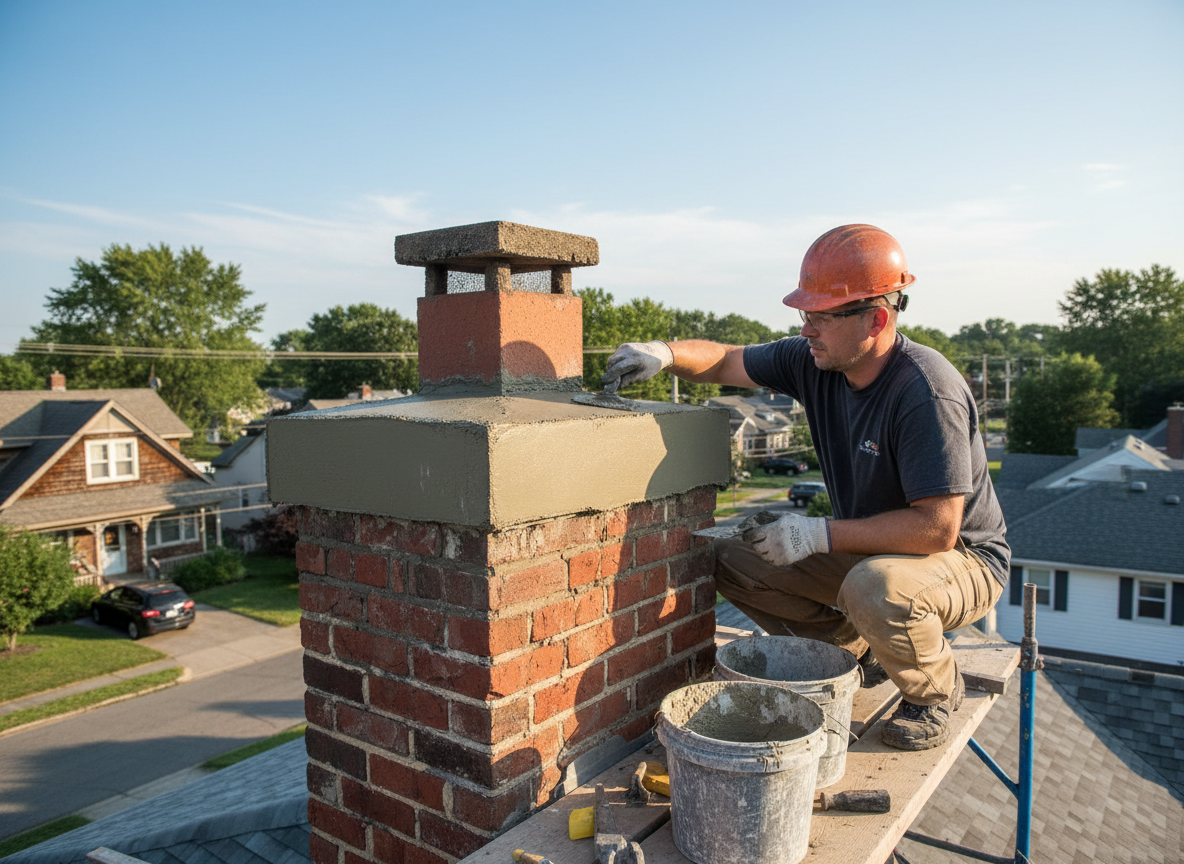
Union sits in Boone County where humid subtropical weather keeps moisture in contact with chimney crowns year-round. Older brick homes common in Ryle and near Union Community Park often have crowns poured without enough slope or proper flashing integration, letting water pool and migrate into the flue. We use a high-temperature refractory mix topped with a flexible acrylic sealer that handles the mild winter temperature swings without cracking the way standard concrete does.
Edge cases here include chimneys on split-level homes along US-42 where the crown sits close to tree cover, trapping damp air and accelerating spalling. We always check the flue tile alignment and the condition of the rain cap before rebuilding, because a misaligned cap can funnel water straight back onto fresh work. In Florence and Burlington homes we see the same pattern: previous repairs that ignored the metal flashing step fail within two seasons.
Code notes for Boone County require the new crown to extend at least two inches beyond the flue on all sides and maintain a minimum quarter-inch-per-foot slope. We never skip the bond breaker between the crown and flue tiles, because direct contact creates stress cracks when the masonry expands in spring humidity. Homeowners who attempt DIY patches with standard mortar watch those patches wash out after the first heavy rain.
Terrain around Union means many driveways sit lower than the house, so runoff from roof valleys can splash up onto the chimney base. That extra water load makes a properly sealed crown critical. We inspect the step flashing where the chimney meets the roof deck on every job, because a crown repair alone will not stop leaks if the flashing is corroded.
Technician insight
In Union, the thing that catches most people out with chimney crown repair is how our humid subtropical climate keeps moisture trapped against the crown on older brick homes near Union Community Park in Ryle. Homeowners often patch with regular mortar that never sets right in the mild winters, so the new crown cracks again within a season because they skip the bond breaker and slope details that actually matter here.
Leaking Crown on Ryle Chimney
Problem: Water stains appearing in attic after spring rains on a Union home. What we found: Hairline cracks in the crown from an earlier flat pour that trapped humidity. What we did: Removed the failed material, rebuilt with sloped refractory mix and sealed flashing. Outcome: Attic stayed dry through the next humid season.
How it works
- 1
On-Site Inspection
We examine the crown, flashing, and flue from the roof and attic, noting slope, cracks, and water paths specific to Union humidity.
- 2
Old Material Removal
Damaged crown sections are cut out without disturbing the flue tiles or existing flashing on homes in Ryle and near Union Community Park.
- 3
New Crown Installation
Refractory mix is formed with correct slope and overhang, then sealed and allowed to cure under local mild winter conditions.
- 4
Final Waterproofing and Check
Acrylic sealer is applied and the entire assembly is tested for runoff before we leave the 10829 US-42 address.
Pricing
Upfront quotes after inspection; price depends on chimney height, extent of prior damage, and whether flashing work is needed.