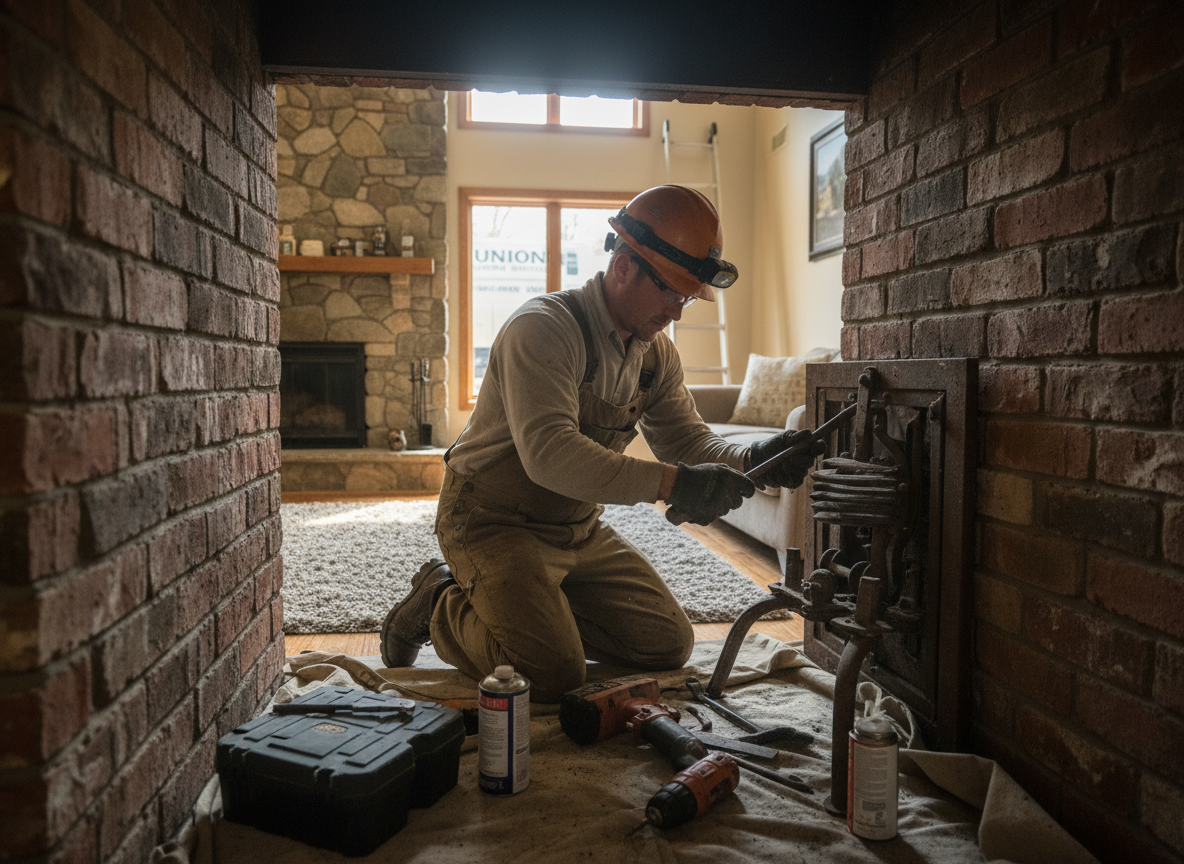
Chimney dampers in Union homes often face corrosion from the region's humid subtropical conditions even with mild winters. Older masonry chimneys common in Ryle neighborhoods built before widespread updates can have cast iron or steel dampers that seize from moisture trapped by nearby tree cover and soil dampness around Union Community Park. Technicians check the throat, cable tension and seal integrity because a failed damper lets cold air and creosote moisture enter living spaces during temperature swings between Florence and Burlington.
Access challenges arise on split-level homes along US-42 where roof pitches and chimney height limit ladder placement. Damper repair here frequently involves replacing warped plates or rusted pivots rather than full flue liner work. Homeowners sometimes attempt DIY lubrication that only masks binding caused by years of wood smoke residue mixed with local humidity. Proper repair restores draft control without disturbing surrounding brick or flashing.
Edge cases include dampers installed too close to the smoke shelf in 1980s Boone County builds where clearance prevents standard replacement parts. In these situations custom fabrication or conversion to a top-sealing damper may be needed to maintain code-compliant airflow. Always verify the firebox condition first because hidden cracks near the damper can allow exhaust backdrafting into the home.
Seasonal Guidance
Mild winters in Union mean less ice damage but higher humidity promotes rust on exposed damper components year-round. Schedule checks after fall leaf drop when debris accumulates on roofs near Ryle, as this can accelerate binding. Spring inspections catch expansion issues from temperature shifts between Burlington and Florence.
Technician insight
In Union, the thing that catches most people out with chimney damper repair is humidity-driven corrosion on pre-1990s metal dampers in Ryle homes where tree cover around Union Community Park traps moisture against the flue year-round.
Stuck Damper Near Union Community Park
Homeowner reported poor draft and cold air infiltration in a Boone County residence off US-42. Inspection revealed a rusted pivot seized from years of humidity exposure. We replaced the plate and cable, restored full movement and confirmed proper seal without masonry disturbance.
How it works
- 1
Initial Assessment
Inspect damper operation from the firebox and roof to identify binding, corrosion or cable failure.
- 2
Access and Cleaning
Remove creosote buildup and test mechanism movement while noting any masonry damage.
- 3
Component Repair or Replacement
Lubricate, realign or swap the damper plate, pivot or cable using materials suited to local humidity.
- 4
Function Test and Seal Check
Confirm smooth open-close action and verify no air leaks around the throat before leaving the site.
Pricing
Upfront quotes after inspection; cost varies with access difficulty and part condition on Union properties.