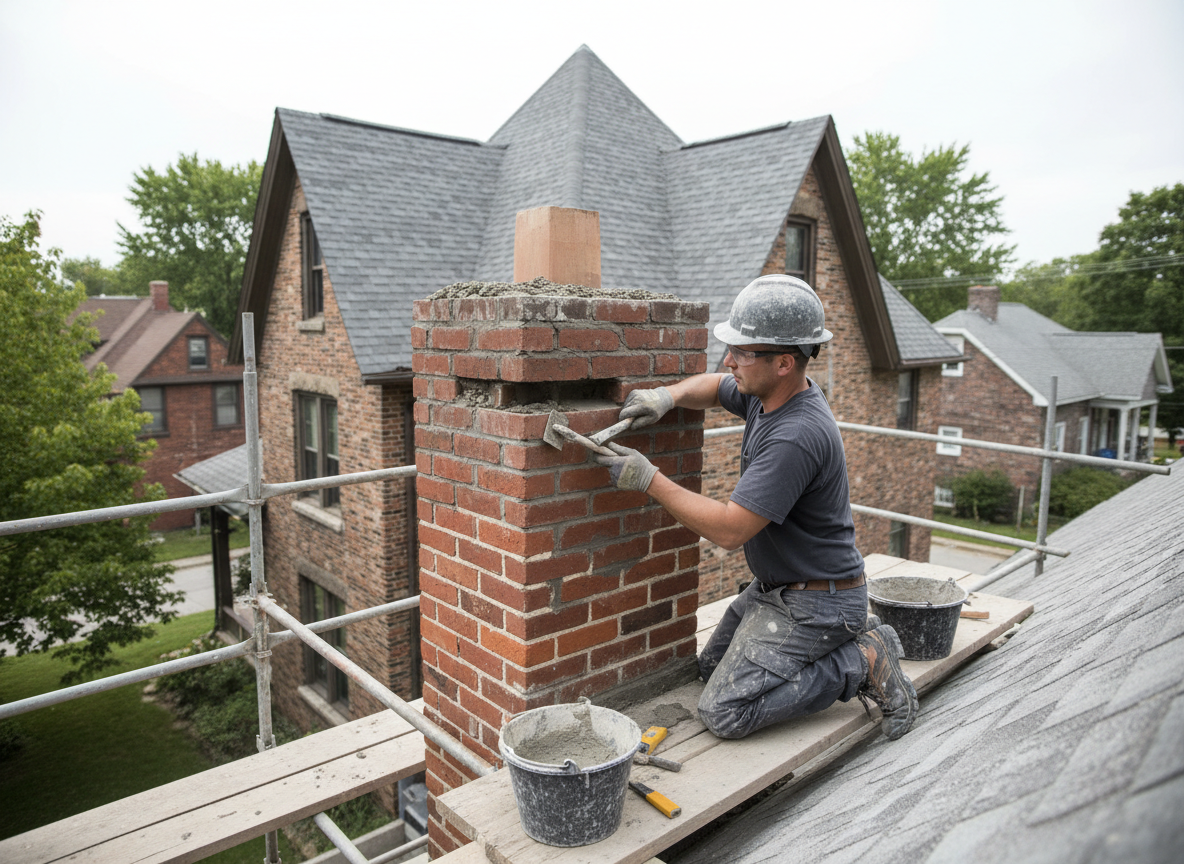
Union sits in Boone County with a humid subtropical climate where even mild winters allow moisture to penetrate aging brick chimneys. Homes built before the 1990s expansion often feature soft lime mortar that crumbles faster near the crown and flue exits. Tuckpointing removes failed mortar to a consistent depth, then packs fresh mortar matched to the original color and hardness so the chimney sheds water instead of wicking it into the attic or walls.
Access on Union properties is usually straightforward from ground ladders, but chimneys on two-story homes near Ryle can require staging because roof pitches and mature trees limit reach. We cut out only the deteriorated joints rather than full repointing, which keeps the original brick faces intact and reduces dust that would otherwise settle across Union Community Park lawns during spring jobs. New mortar is tooled concave to shed rain while matching the historic profile common on older Burlington Road addresses.
Boone County code requires chimneys to remain weathertight after any masonry work; we verify flue clearance and crown condition before closing joints. Leaving soft mortar in place lets freeze-thaw cycles widen gaps each winter, eventually allowing water to reach the liner and create interior staining that shows up first in second-floor ceilings.
Seasonal Timing
Tuckpointing in Union is best scheduled after the last hard frost but before summer humidity peaks, so the new mortar cures evenly without rapid drying or trapped moisture.
Technician insight
In Union, the thing that catches most people out with chimney tuckpointing is how the mild winters still let trapped moisture expand and pop mortar on chimneys that face west; the prevailing winds drive rain right into the joints on older brick homes along US-42.
West-Facing Chimney on Ryle Road
Water stains appeared on a second-floor ceiling after heavy spring rain. We found eroded mortar on the west face where wind-driven moisture had worked into the joints. Only the damaged sections were cut out and repointed with matching mortar; the rest of the chimney remained untouched. The homeowner reported no further staining the following winter.
How it works
- 1
Site Inspection
We examine every joint from crown to roofline, noting water paths, previous repairs, and brick condition on Union and Ryle chimneys.
- 2
Mortar Removal
Failed mortar is cut out to a uniform depth using hand tools to avoid damaging surrounding brick on older Boone County homes.
- 3
Joint Cleaning and Dampening
Dust and debris are removed, then joints are lightly dampened so new mortar bonds without rapid moisture loss in local humidity.
- 4
Mortar Placement and Tooling
Fresh mortar is packed in layers and tooled concave to match existing profiles while directing water away from the brick faces.
- 5
Final Cure Check
We return after initial set to confirm proper curing and perform a water test before leaving the site.
Pricing
Pricing varies with chimney height, number of sides requiring work, and access constraints on two-story Union homes.