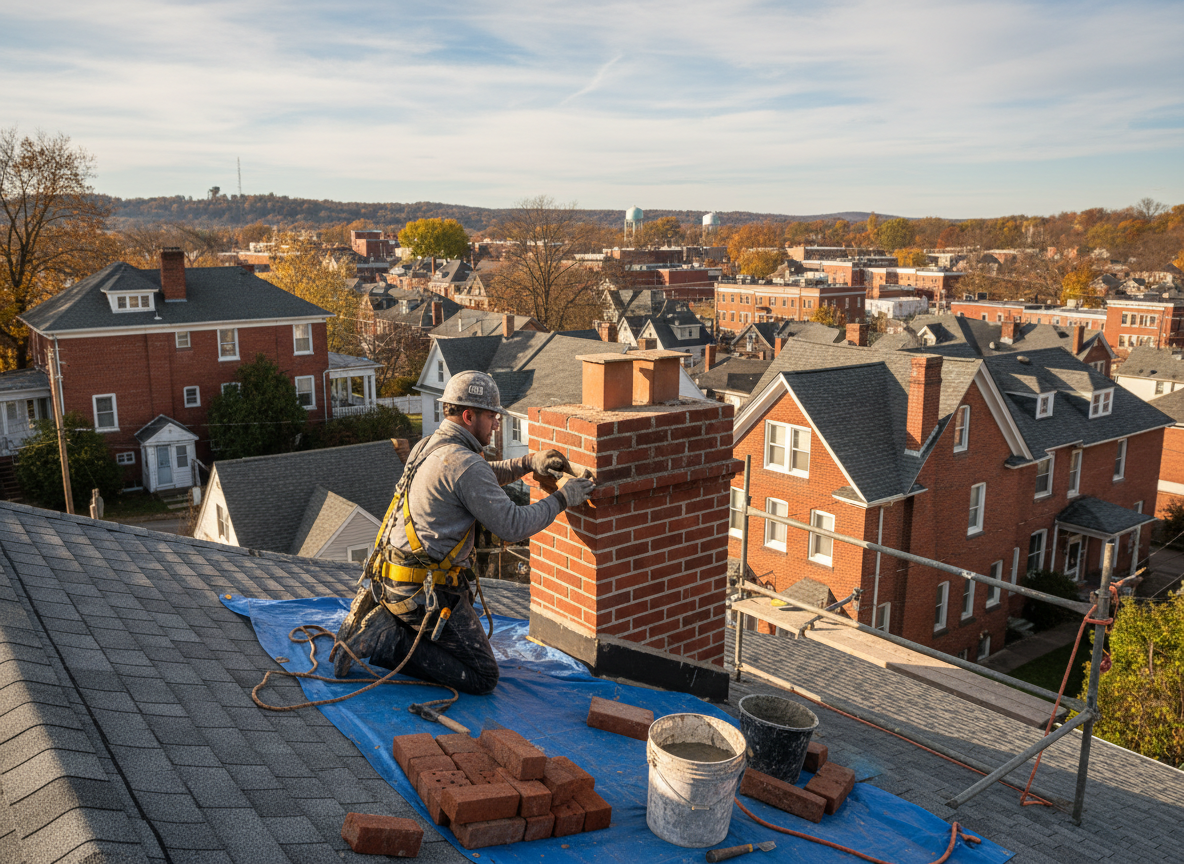
Roof chimney repairs in Union often center on the intersection of the chimney stack and asphalt shingles common on homes built from the 1980s onward in Ryle and around Union Community Park. Humid subtropical conditions allow moisture to linger under step flashing and counter flashing, especially where roof planes meet the chimney. Mild winters reduce ice damage but increase the chance of algae and moss growth that holds water against mortar joints and metal flashings, accelerating deterioration.
Technicians working these jobs check the cricket or saddle behind the chimney first because water tends to pool there during heavy summer storms that move through Boone County. We also examine the crown for hairline cracks that let rain enter the flue liner and drip down into the attic space. Access from the roof requires proper staging on the steeper pitches found on many two-story homes near Florence and Burlington, and we always verify that any new flashing integrates with existing underlayment without disturbing the ridge vent.
When replacing damaged flashing we use pre-formed aluminum or copper pieces sized to the specific brick or stone chimney width rather than generic roll material. This prevents future gaps at the corners where wind-driven rain from the southwest commonly enters. Homeowners in Union should note that any repair must maintain proper clearance from combustible roofing materials to stay within local building expectations, and we photograph the entire assembly before closing up so the owner can see exactly what was addressed.
Technician insight
In Union, the thing that catches most people out with roof chimney repair is how the mild winters let humidity keep working on the flashing year-round, especially on homes in Ryle where roof planes slope toward the chimney and water sits instead of running off quickly.
Hidden Rot Behind the Chimney
Water stains appeared on a ceiling in a Union home after summer storms. We found the cricket had failed and moisture had traveled under the shingles into the deck. We replaced the cricket, installed new copper flashing, and sealed the crown. The attic stayed dry through the next heavy rain.
How it works
- 1
Roof Assessment
We climb the roof from 10829 US-42 to inspect flashing, crown, and cricket condition while noting any impact from nearby tree cover in Ryle.
- 2
Moisture Mapping
Using a moisture meter we trace water intrusion paths through the roof deck around the chimney to identify hidden rot before it spreads into attic insulation.
- 3
Flashing Replacement
Old step and counter flashing is removed and new pieces are cut and sealed to match the existing roof slope and chimney profile.
- 4
Crown and Joint Repair
Cracks in the chimney crown are filled and mortar joints are repointed where humidity has caused softening, then the area is tested with a hose.
- 5
Final Documentation
We photograph the completed work and walk the homeowner through what was found and how the repair prevents future leaks during Boone County rains.
Pricing
Cost depends on roof pitch, chimney height, and extent of hidden deck damage; we provide an upfront assessment before any work begins.